Escalator & Moving Walkway: What’s The Differences?

Both escalators and moving walks fall under special equipment defined by Chinese Standard GB16899. However, they differ greatly in structure, inclination angle and application scenarios.
Definition of Escalator & Moving Walkway
Escalator
An escalator is a continuous circulating passenger conveying device with moving steps. It is mainly used to transport large pedestrian flows between building floors. And improve passenger circulation efficency in public areas. Escalators are widely installed in shopping malls, airports,railway station ,metro stations and public transportation hubs.
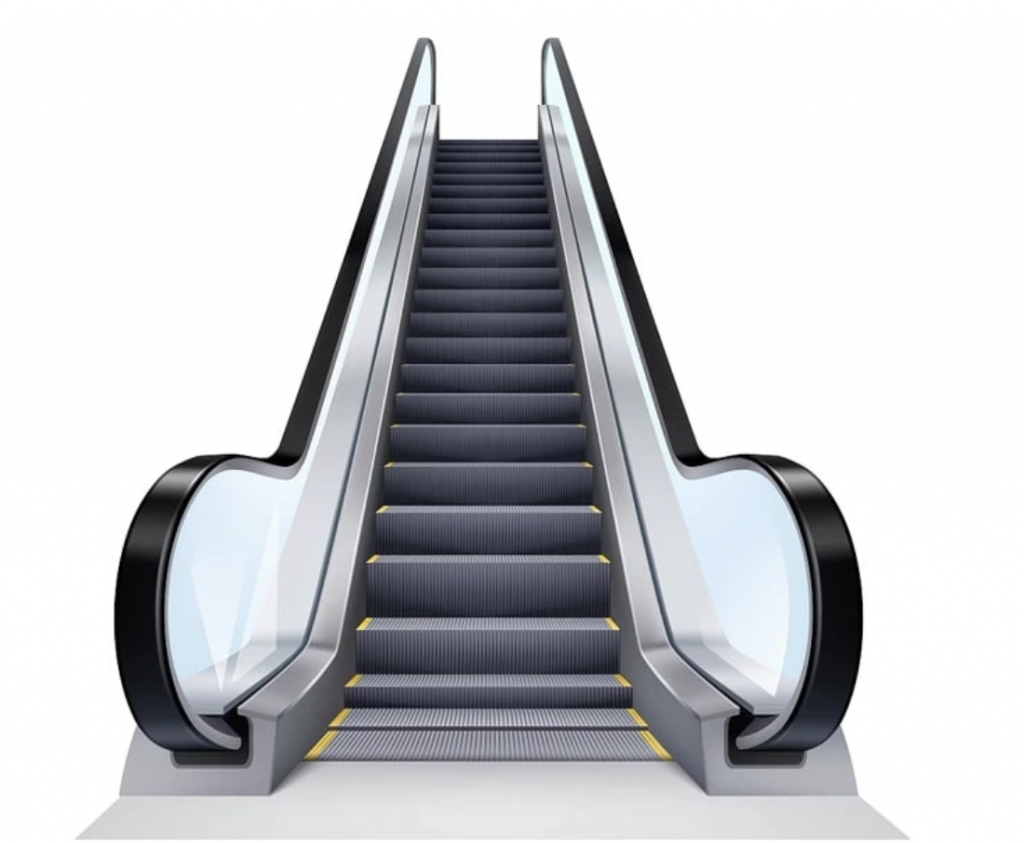
Get Advice from MINI MUSTANG Experts on Escalators! Click here!
Moving Walkway
A moving walk is also known as an autowalk, travellator, or travelator,a step-free passenger conveyor with flat pallets or rubber belts. They are similar to escalators. It serves long-distance passenger transportation on horizontal or gently inclined paths and supports trolleys, commonly used in airport terminals, large supermarkets and exhibition centers.
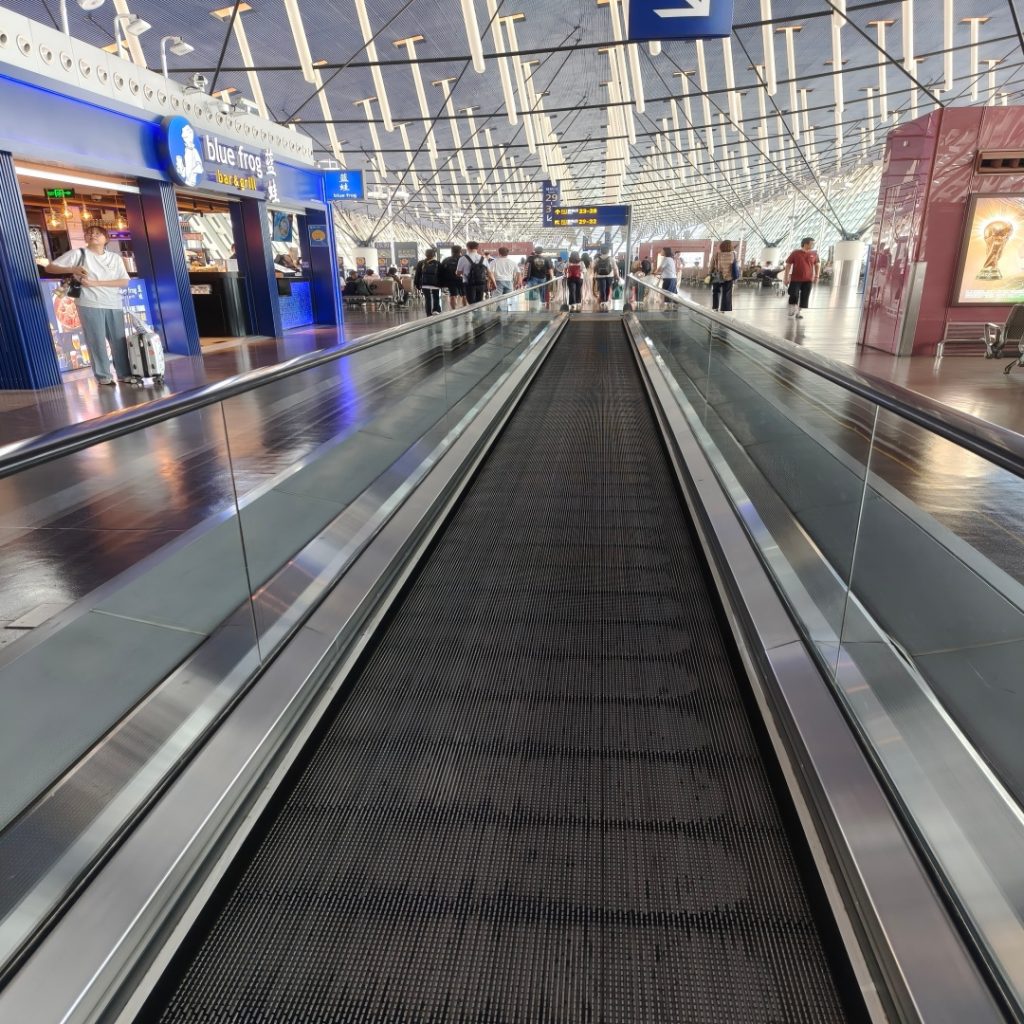
Get Advice from MINI MUSTANG Experts on Moving Walks! Click here!
Escalator vs Moving Walkway
Both escalators and moving walks fall under special equipment defined by Chinese Standard GB16899. However, they differ greatly in structure, inclination angle and application scenarios.
- Bearing Surface (Quick Identification)
- Escalator: Equipped with circulating moving steps for vertical travel. The steps will automatically level off and loop back.
- Moving Walk: Fitted with flat pallets or rubber belts, with no steps. It works like a moving flat conveyor. Passengers can take luggage trolleys and shopping carts directly onto it.
2. Inclination Angle (Key Technical Parameter)
- Escalator: Commonly at 30° / 35°, steep inclination. Designed for crossing floors with large lifting height (e.g., 2–3 m floor height in shopping malls).
- Moving Walk: Maximum inclination ≤12°, and can also be fully horizontal (0°). It is only used for small height differences or long horizontal conveyance, and cannot handle large floor-to-floor lifting.
3. Application Scenarios
- Escalator: Widely installed in shopping malls,hospitals, metro stations and railway stations to carry passengers vertically between floors over short height differences.
- Moving Walk: Commonly seen in airport terminals, large supermarkets and exhibition centers. It provides long-distance transportation on gentle slopes or horizontally, convenient for luggage and shopping trolleys (the long flat conveyors in airports are typical examples).
4. Differences in Structure, Load & Selection
1. Steps / Pallets: Escalators use steps; moving walks adopt flat pallets or belts that can bear the wheels of trolleys.
2. Lifting Height: Escalators achieve large lifting height; moving walks have limited lifting height but can reach very long conveying distances.
3. Speed: Their standard rated speeds are similar. Moving walks are more suitable for passengers carrying bulky luggage.
4. Safety Protection: They share most safety devices, but their type test certificates are separate. Escalator certificates are for steps while moving walk certificates are for pallets. The certificates cannot be interchanged in export certification and bidding.
- Summary
✅ Escalator = moving staircase with steps, steep angle, for vertical travel between floors
✅ Moving Walk = moving flat walkway, no steps, gentle slope, for long-distance transfer with trolleys
Similarities: Components of Escalator and Moving Walkway
Steps/treads
Steps or treads are the flat surfaces on which people stand and walk while using an escalator or moving walkway. They are typically made of durable materials such as metal or plastic. They are designed to be slip-resistant and easy to clean.
Handrails
Handrails are long bars that run alongside the steps or treads. They provide support and stability for users as they move up or down the escalator or moving walkway. They can be made of various rubber, plastic, or metal materials. They are designed to be comfortable to hold and easy to clean.
Drive System
The drive system is the mechanism that powers the movement of the steps or treads. It typically consists of a motor, gears, and a drive belt or chain. The motor generates the power to move the steps or treads, while the gears and drive belt or chain transmit the power to the steps or treads.
Safety Features
Safety features are an essential component of escalators and moving walkways. Some standard safety features include emergency stop buttons, safety sensors, and skid-proof surfaces:
Emergency stop buttons allow users or operators to quickly stop the escalator or moving walkway in an emergency.
Safety sensors detect obstacles or problems on the escalator or moving walkway and shut them down if necessary.
Skid-proof surfaces help to prevent slips and fall.
Conclusion
MINI MUSTANG Elevator is a leading provider of escalators, moving walkways, and other transportation systems. We are committed to providing our customers with the best possible experience. If you are looking for a reliable and efficient transportation system for your Building Projects, Contact us today to learn more about our products and services.

 Chinese